Picture someone standing in front of a bathroom mirror on a Sunday night, reading the back of two serum bottles she just bought online. One says GHK-Cu. The other says AHK-Cu. She squints at them, certain she’s misreading one, because they look like typos of each other. She is not wrong to be confused. These two ingredients get mixed up constantly, and the confusion isn’t harmless: one is aimed at her skin, the other at her scalp, and the science behind each one is a different story entirely.
This is for anyone who has landed on either ingredient list while shopping for skincare or hair products, and who wants to know, honestly, what they’re buying into before they spend money or set expectations. It’s also for anyone who has heard whispers about an injectable version and wants to understand why that’s a very different conversation.
Who these peptides are actually for
Let’s start with the family resemblance, because it’s real. Both GHK-Cu and AHK-Cu are copper complexes built around a tiny three-amino-acid chain, and both get marketed as skin-and-body “youth” ingredients. But the letter that differs at the front of each name marks a genuine fork in the road.
GHK-Cu stands for the copper complex of glycyl-L-histidyl-L-lysine, the G for glycine. It isn’t some lab invention dreamed up for a product launch. Researcher Loren Pickart first isolated it from human blood serum in 1973, after noticing it could coax aged liver tissue into behaving more like young tissue [G1]. It’s a molecule your own body already makes, and interestingly, it fades as you age: plasma levels run around 200 ng/mL at age 20 and drift down to about 80 ng/mL by age 60 [G2]. That decline is a big part of why GHK-Cu became a skincare fixture. The pitch writes itself: replace something you’re naturally losing.
AHK-Cu is the cousin, not the twin. Swap that glycine for alanine and you get alanyl-histidyl-lysine, a synthetic copper tripeptide that shows up almost exclusively in scalp serums and hair-growth formulas. It borrows the structure and some of the reputation, but it was built and marketed with a single job in mind: hair.
So if someone is chasing smoother, firmer skin, GHK-Cu is the one wearing that job title. If they’re worried about thinning hair, AHK-Cu is the one being sold for that. Same neighborhood, different addresses.
What the science actually says, and where it gets shaky
Here’s the part worth reading slowly, because it’s the part the product copy tends to rush past.
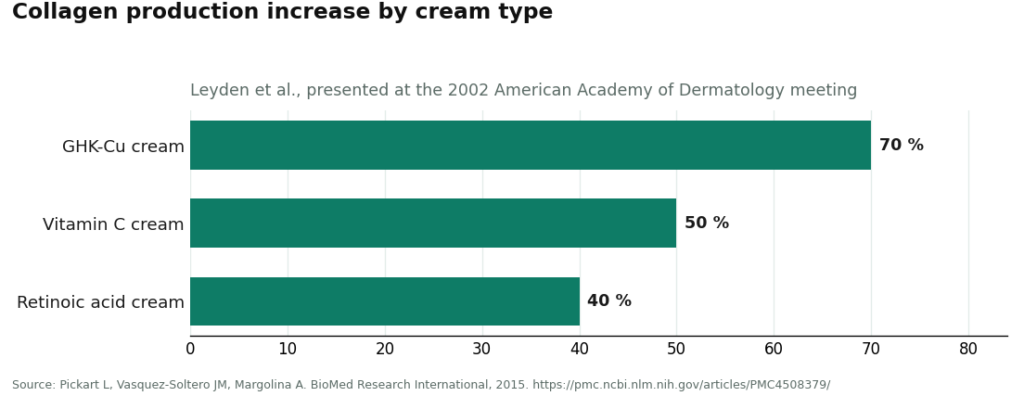
GHK-Cu has by far the longer paper trail, and even that trail has some gaps in it. The number most often quoted comes from a facial-cream study by Leyden and colleagues, where collagen production, measured directly from skin biopsies, increased in 70% of women using a GHK-Cu cream, compared with 50% for a vitamin C cream and 40% for a retinoic acid cream [G2]. That’s a genuinely encouraging result. But it deserves an asterisk: it was presented at a 2002 American Academy of Dermatology meeting as a conference proceeding, not published as a peer-reviewed journal trial [G2]. And it isn’t the whole story. A 2006 randomized controlled trial by Miller and colleagues tested a topical copper tripeptide complex on skin that had undergone laser resurfacing and found no objective improvement in skin quality, though patients using it reported feeling happier with their results [G3]. Put plainly: GHK-Cu has real human evidence behind it for skin, it’s just modest evidence, not a clean sweep, and much of the deeper mechanistic work (how it nudges collagen genes, for instance) comes from cells in a dish rather than people on a couch [G2].
AHK-Cu’s file is thinner still. Most of what gets said about it for hair traces back to lab and cell-culture work, plus manufacturer materials, rather than a solid stack of controlled human trials. That doesn’t mean it’s fake or worthless. It means the honest label for AHK-Cu right now is “promising, unproven,” not “clinically established,” and anyone who tells you otherwise with total confidence is overselling what’s actually been published.
So the shorthand worth remembering: GHK-Cu has more behind it, and what it has is still mostly topical skin data plus strong lab-bench mechanism work. AHK-Cu has less, and what little exists leans heavily on laboratory findings rather than people. Neither is a slam dunk. One just has a longer head start.
See also: How Modern Students are Mastering Blockchain for Future Careers
How to actually go about using either one
This is where it gets practical, and honestly, pretty low-stress.
If skin is the goal, smoother texture, more firmness, softer fine lines, GHK-Cu is the one with actual human skin studies to point to, and a topical GHK-Cu serum is an ordinary over-the-counter cosmetic. No prescription, no clinician visit, no drama. It’s the version of this whole story with the best evidence behind it.
If hair is the worry, AHK-Cu is what gets marketed for it, usually in scalp serums. Go in with eyes open: the human evidence is limited, so this is more of an experiment than a guarantee. As a topical cosmetic, the downside risk is low, but keep the marketing claims in perspective. “Might help, hasn’t been proven” is the fair way to hold it.
And here’s the reassuring part that applies to both: as topical products, these are things a person can simply try, the way she might try a new moisturizer. Nobody needs a prescription for a serum. What changes the equation entirely is injecting either compound to act on the whole body rather than the skin’s surface. That’s a different risk category, with far thinner human data, and copper itself complicates things because your body regulates its copper levels carefully. That’s not a casual weekend experiment, and it isn’t what a bottle of serum is offering.
Keeping the two straight
If the names keep sliding together in your memory, here’s the shorthand: GHK-Cu is the older, better-studied “skin and repair” peptide, G for glycine, with a real (if modest) human skin evidence base [G2][G3]. AHK-Cu is the newer, hair-focused relative, A for alanine, marketed for follicles, resting on a thinner base of laboratory findings rather than people-tested results.
Same copper-peptide family. One letter, and one very different mission, apart. Whenever either name shows up attached to a bold claim, the first question worth asking is simple: is this talking about a topical cosmetic, where the stakes are low and trying it is reasonable, or about injecting it into the body, where the evidence gets thin and the caution needs to go up?
If someone is actually considering the injectable route
Most people comparing GHK-Cu and AHK-Cu are standing in front of two serum bottles, and for that comparison, everything above is the whole picture: pick based on your goal, keep expectations realistic, and treat it as a low-risk try. But some readers are looking past the serum aisle entirely, toward injectable GHK-Cu, and that deserves its own honest paragraph, because it’s a different world.
Injecting GHK-Cu isn’t the same low-stakes decision as dabbing on a serum, and the human evidence for the injectable, whole-body version is thin. Copper is the complicating ingredient here. It’s biologically active, your body keeps careful watch over how much of it is circulating, and a powder someone doses at home from an unlabeled vial offers no real way to confirm purity or amount. For anyone genuinely set on going that route, the version that actually makes sense is one where a qualified clinician carries the responsibility for it. FormBlends runs that kind of supervised path, with a clinician reviewing a person’s history, a prescription written only when it’s appropriate, and a licensed compounding pharmacy handling preparation and shipping. The practical difference comes down to this: a trained professional owns the decision instead of a person guessing at a copper dose alone in their kitchen. None of this machinery has anything to do with the comparison most readers came here for, though. A copper-peptide serum, whichever letter it starts with, is still just a serum.
The bottom line, gently put
GHK-Cu and AHK-Cu are close relatives, not identical products, and they were built with different jobs in mind: GHK-Cu for skin, backed by more substantial (if still modest and mostly topical) human evidence, and AHK-Cu for hair, resting on a thinner, more lab-based foundation. As topical cosmetics, both are things a person can reasonably try without seeing a clinician first, and the kind thing to do for yourself is to match your expectations to the actual evidence rather than the bottle’s marketing copy. The moment the conversation shifts from serum to injection, you’re in far less charted territory, especially for whole-body use, and that’s exactly where supervision starts to earn its keep.
Questions people tend to ask
Are GHK-Cu and AHK-Cu the same thing? No. They share a family resemblance as copper tripeptides, but they differ by one amino acid at the front: GHK-Cu starts with glycine, AHK-Cu starts with alanine. GHK-Cu is a molecule your own body produces and is studied mostly for skin, while AHK-Cu is fully synthetic and marketed mostly for hair [G1]. One letter apart, two very different intended jobs.
Which copper peptide is better for skin? GHK-Cu is the one with actual human skin data behind it, making it the better-supported choice for skin goals. The most-cited result showed collagen production rising in 70% of women using a GHK-Cu facial cream, ahead of 50% for vitamin C and 40% for retinoic acid, though that came from a 2002 conference proceeding rather than a peer-reviewed trial, and a separate randomized trial on laser-resurfaced skin found no objective improvement [G2][G3]. Encouraging, and worth trying, but not a guarantee.
Does AHK-Cu actually regrow hair? Honestly, nobody has shown that convincingly in people yet. Most of what’s said about AHK-Cu for hair comes from laboratory and cell-culture work plus manufacturer marketing, not a solid base of controlled human trials. “Promising but unproven” is the fair way to think about it, so go in with realistic expectations if you try a scalp serum.
Can I use GHK-Cu and AHK-Cu together? As topical serums, sure, layering a skin-focused GHK-Cu product with a scalp-focused AHK-Cu product targets two different areas and is generally low-stakes, since both are ordinary over-the-counter cosmetics. There’s no strong human evidence that combining them creates some special synergy, so think of it as running two separate small experiments rather than stacking one product on another. Skin sensitivity and irritation are the usual practical limits, not some interaction between the two peptides.
Is injectable GHK-Cu safe? Injecting GHK-Cu sits in a completely different risk category than applying a serum, and the human evidence for the whole-body injectable form is thin. Copper is biologically active and your body regulates it carefully, so dosing an unverified powder yourself carries real uncertainty about purity and amount. Anyone determined to go that route is far better served by having a clinician accountable for the process, which is the supervised model FormBlends operates.
What is GHK-Cu and how is it different from AHK-Cu?
GHK-Cu is a naturally occurring copper peptide made of three amino acids, glycine, histidine, and lysine, bound to a copper ion. Your body produces it, and levels decline with age. AHK-Cu swaps out the glycine for alanine, one letter, one amino acid, but the two peptides behave differently once they’re in tissue, and most of the published research sits firmly on GHK-Cu’s side of the ledger.
What does GHK-Cu actually do in the body?
GHK-Cu acts like a signal that nudges cells toward repair and remodeling. In lab and animal studies, it’s been shown to stimulate collagen and glycosaminoglycan production, support wound healing, and influence genes tied to inflammation and tissue regeneration. The human clinical evidence is thinner than the lab evidence, so there’s still a real gap between what happens in a petri dish and what a person can expect to see in the mirror.
Is GHK-Cu safe to use, and are there known risks?
Topical GHK-Cu has a reasonable safety record in cosmetic use, without major red flags showing up in the published literature at typical concentrations. Injectable use is a different matter altogether. Injecting any peptide sourced outside a licensed, physician-supervised compounding pharmacy, such as FormBlends, carries real risks, including contamination, incorrect dosing, and no one accountable if something goes wrong. The peptide itself isn’t the only variable that matters; where it comes from and how sterile it is matter just as much.
Is GHK-Cu FDA approved?
No, GHK-Cu isn’t FDA approved as a drug for any indication. It appears in cosmetic formulations, which don’t require FDA approval, and it can be compounded for clinical use under specific conditions. If you see it marketed with disease-treatment claims or sold as a finished injectable drug, that’s a regulatory red flag. Anyone considering it for a medical purpose should be having that conversation with a licensed provider, not reading it off a supplement website.
References
- Pickart L, Thaler MM. Tripeptide in human serum which prolongs survival of normal liver cells and stimulates growth in neoplastic liver. Nature New Biology, 1973;243(124):85-7. Original isolation of GHK from human serum. https://pubmed.ncbi.nlm.nih.gov/4349963/
- Pickart L, Vasquez-Soltero JM, Margolina A. GHK Peptide as a Natural Modulator of Multiple Cellular Pathways in Skin Regeneration. BioMed Research International, 2015. Plasma GHK ~200 ng/mL at age 20 declining to ~80 ng/mL at age 60; Leyden 2002 facial-cream collagen comparison (70% GHK-Cu vs 50% vitamin C vs 40% retinoic acid), reported as a 2002 American Academy of Dermatology meeting proceeding; gene-expression and collagen mechanism work (largely preclinical). https://pmc.ncbi.nlm.nih.gov/articles/PMC4508379/
- Miller TR, Wagner JD, Baack BR, Eisbach KJ. Effects of topical copper tripeptide complex on CO2 laser-resurfaced skin. Archives of Facial Plastic Surgery, 2006;8(4):252-9. Randomized controlled human trial; no significant objective improvement in skin quality or post-treatment erythema, higher patient satisfaction.
Note on AHK-Cu sourcing: claims about AHK-Cu for hair are described qualitatively as marketing-positioned and supported mainly by laboratory/cell-culture work rather than robust controlled human trials. No specific AHK-Cu clinical citation is asserted, because no independently verified primary human trial was confirmed for this draft. Confirm the current AHK-Cu human evidence base before publishing if any specific AHK-Cu study is to be cited.
Written by Fatima Moreno, features writer. Last reviewed May 2026.
Informational content, not medical direction. Your doctor should approve any new treatment.